MAX Energy
Operations
Ops
Max Energy operates an integrated midstream system that delivers crude oil from the Permian and Eagle Ford Basins into terminal storage and marine export infrastructure at the Port of Calhoun.
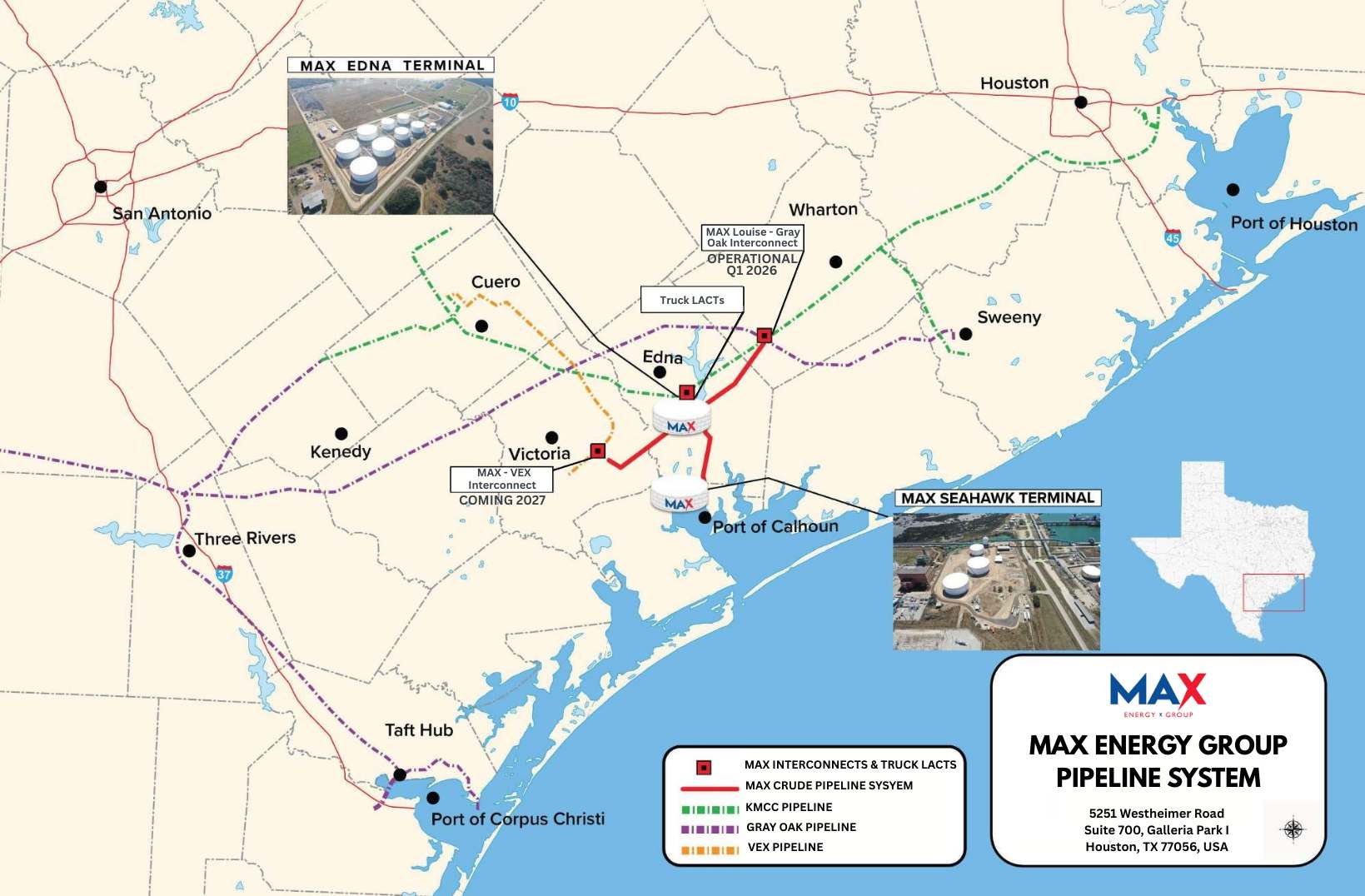
The Max Louise – Gray Oak Interconnect provides access to Permian and Eagle Ford crude grades, delivering pipeline volumes directly into the Edna Terminal. Truck volumes are also received at the Edna Terminal, supplementing pipeline deliveries and supporting blending operations. From the Edna Terminal, crude flows through Max-owned pipeline infrastructure to the Seahawk Terminal for barge and vessel loading.
This integrated system is designed to optimize marine logistics, enabling efficient staging, rapid vessel and barge loading, and reliable execution of export movements. Max’s dedicated marine infrastructure and low-congestion port access support quick, efficient, and cost-effective crude exports to domestic and international markets.
PIPELINES
The Max Pipeline System consists of approximately 350 miles of 8–16 inch pipelines along the Texas Gulf Coast and is strategically positioned to interconnect with major crude takeaway systems moving barrels from the Permian and Eagle Ford Basins toward Corpus Christi, Houston, and the Port of Calhoun.
The system provides reliable crude transportation into Max’s terminal network, serving as the primary intake for volumes delivered to the Edna Terminal and onward to Gulf Coast domestic and international export markets.
Key Connectivity
- Direct access to Permian and Eagle Ford crude grades via the Max Louise – Gray Oak Interconnect
- Interconnection with the Victoria Express Pipeline (VEX) (planned 2027)
- Optionality for future connectivity leveraging Max’s expansive South Texas ROW footprint
Edna Terminal
The Edna Terminal serves as the primary storage and blending hub within Max’s integrated midstream system, receiving pipeline volumes and complementing them with truck deliveries. Crude staged at Edna flows directly through Max-owned pipeline infrastructure to the Seahawk Terminal for marine export, with optionality to deliver pipeline volumes directly to the Seahawk Terminal, bypassing Edna storage.
1.5 million barrels of crude / condensate storage capacity in operation, consisting of:
- 4 × 125,000 bbl API 650 IFR storage tanks
- 4 × 250,000 bbl API 650 IFR storage tanks
Six truck LACT bays equipped with Variable Frequency Drives (VFDs).
SEAHAWK TERMINAL
The Seahawk Terminal is Max Energy Group’s marine loading and export facility at the Port of Calhoun, designed to efficiently load crude delivered via Max-owned pipeline infrastructure and support barge movements, Panamax-class vessel exports, and reverse lightering operations to access larger export markets.
- 612,000 barrels of crude / condensate storage capacity in operation, consisting of:
- 2 × 250,000 bbl API 650 IFR storage tanks
- 1 × 112,000 bbl API 650 IFR storage tank
- Capable of loading up to Panamax-class vessel
- Liquids pier equipped with loading arms for domestic and international vessels up to 15,000 Barrels Per Hour (BPH)
- Dedicated Multi-Purpose Dock (MPD) with two barge / ATB loading berths, capable of loading two barges simultaneously up to 10,000 BPH
PORT EXPANSION
The Matagorda Ship Channel Improvement Project (MSCIP) is sponsored by the Calhoun County Port Authority. Congress authorized the Army Corps of Engineers to construct the MSCIP in Calhoun and Matagorda Counties. This project will improve the navigational efficiency and operational safety of the deep-draft navigation system of the port. The result of the project will allow the users of the Port of Calhoun to accommodate up to Aframax class ships. More updates to come on the Port of Calhoun deepening and widening project.
PORT / BAY PILOT CONTACT DETAILS
For the Port of Calhoun information, please click here
For Matagorda Bay Pilot information, please click here
ENVIRONMENT & SAFETY